Cold spots are your radiator telling you something
If your rooms are slow to warm up or a radiator feels patchy to the touch, it is usually a sign that something in your system needs a little attention. The good news is that where the cold spot is often tells you exactly what the problem is, and some fixes are safe to do yourself.
Cold at the top usually means trapped air
If a radiator is warm at the bottom but cold across the top, the most likely cause is trapped air. Air rises to the top of the radiator and stops hot water filling that section, so the top stays cool. The fix is to bleed the radiator, which releases the trapped air.
Cold at the bottom usually means sludge
If a radiator is warm at the top but cold along the bottom, bleeding will not help. This pattern typically points to a build-up of sludge, rust and debris settling at the base of the radiator and restricting flow. Clearing that usually needs a chemical flush or, in worse cases, a power flush carried out by a heating engineer, so this is not a DIY job.
How to bleed a radiator safely
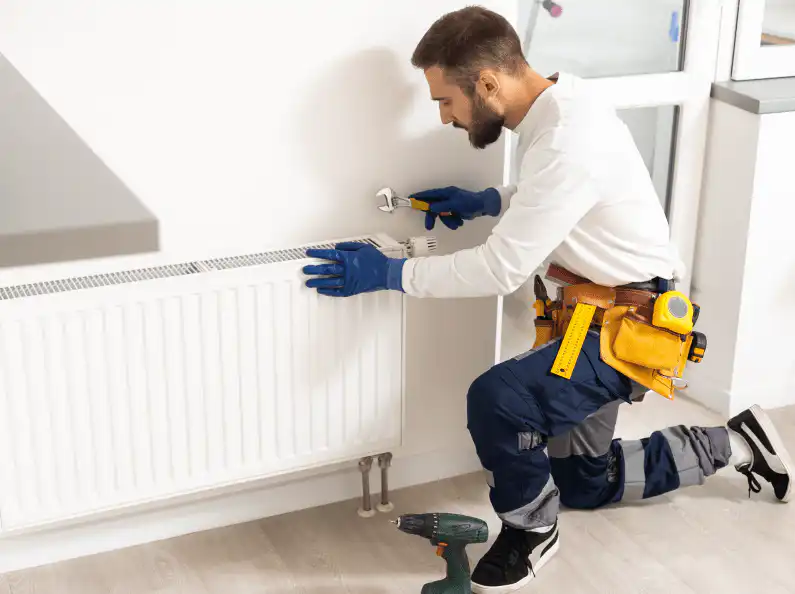
Bleeding is straightforward if you take it steadily:
- Turn off your central heating and let the radiators cool completely. Bleeding a hot system risks scalding.
- Start with the right radiator. Begin with the downstairs radiator furthest from the boiler, work around the ground floor, then move upstairs. Working from lowest to highest gives the best result.
- Have a cloth and small container ready to catch drips.
- Locate the bleed valve at the top of one end of the radiator.
- Turn the radiator key anti-clockwise slowly, just a quarter to half turn. You will hear a hiss as air escapes.
- When water starts to trickle out steadily rather than hissing, the air is gone. Close the valve firmly, but do not overtighten.
- Wipe up any drips and move on to the next radiator.
Once you have finished, turn the heating back on and check your boiler’s pressure gauge. Bleeding can lower system pressure, so you may need to top it up using the filling loop, usually to around 1 to 1.5 bar when the system is cold. Check your boiler manual first.
What is balancing, and why it matters
Bleeding removes air, but it does not control how evenly hot water is shared between radiators. If some rooms are always toasty while others never quite get there, your system may need balancing.
Balancing adjusts the small “lockshield” valve at the base of each radiator so that water is distributed correctly around the house. Without it, the boiler pushes most of the flow to the radiators nearest and easiest to reach, leaving those furthest away underperforming.
Balancing is more involved than bleeding. It usually requires two thermometers (or a suitable digital thermometer) to measure the flow and return temperatures at each radiator, then adjusting each lockshield valve in turn, starting with the radiator that heats up fastest. It takes patience and a methodical approach, and while a confident DIYer can attempt it, many people prefer to have an engineer do it properly.
When to call a heating engineer
Some situations are beyond a bleed key. Contact a qualified engineer if:
- A radiator stays cold after bleeding correctly, which may indicate a faulty valve or a blockage.
- Your radiator is cold at the bottom, suggesting sludge that needs flushing.
- You are having to bleed radiators every few months, which can point to a leak, a faulty valve or an expansion vessel problem letting air into the system.
- Your boiler pressure keeps dropping or you see any signs of a leak.
- You are uncomfortable topping up boiler pressure or working around the boiler itself.
Any work involving the boiler or gas components should always be carried out by a Gas Safe registered engineer. Never attempt gas-related repairs yourself.
A little maintenance goes a long way
Bleeding your radiators once a year, ideally at the start of the heating season, keeps your system running efficiently and your home warming up faster. If you notice recurring cold spots, uneven heating or dropping pressure, it is worth having the system checked before winter really bites here in Norfolk.
Need a hand with your radiators? Call Norfolk Heating Ltd
If your radiators are cold in the wrong places, need balancing, or your system could do with a flush, our Gas Safe registered engineers can help homes across Norwich and Norfolk. Call 07751 261207, email enquiries@norfolkheatingltd.co.uk, or visit Prestige House, Avian Way, Norwich NR7 9AR. We are open Monday to Friday, 7:30am to 5:00pm.